The Chicken Caper
East Texas Flashback — The Homestead Days
The East Texas morning broke slow and muggy, the way it always did in summer — the kind of heat that was already building at dawn, like the sun had something to prove. Inside the farmhouse, Gunner’s nose twitched. His internal clock — which was really just his stomach — told him it was approximately 6:47 AM, which meant breakfast was exactly thirteen minutes late.
He padded into the kitchen where the three boys were already causing their usual chaos. The oldest was stacking his cereal bowl with military precision, because that’s how he did everything. The middle one was drawing something on a napkin — a treasure map, maybe, or a dinosaur, or a dinosaur holding a treasure map. The youngest was wearing his shirt backward and didn’t seem to care. He also appeared to be vibrating.
“Gunner!” the youngest shouted, launching himself off the chair and wrapping his arms around the black Lab’s neck. Gunner’s tail became a propeller of pure joy. Pets. Finally. This was almost as good as food. Almost.
Tiger the cat materialized from nowhere, as cats do, and weaved between Gunner’s legs with a purr that sounded like a small motor. They’d been inseparable since that first cold night last winter when Tiger had curled up against Gunner’s belly. Now they were partners. Brothers. A team.
Even if Tiger was clearly the brains of the operation.
“Boys! Chickens are out!” Dad’s voice boomed from outside.
The morning exploded into action. All three boys scrambled for the door, and Gunner knew — knew — that this was his moment. This was what he was born for. He was a hero. A champion. A chicken-herding prodigy.
“Gunner, no—” the oldest started, but it was too late.
Ninety pounds of enthusiastic black Labrador burst through the door like a furry cannonball, Tiger trotting calmly behind him.
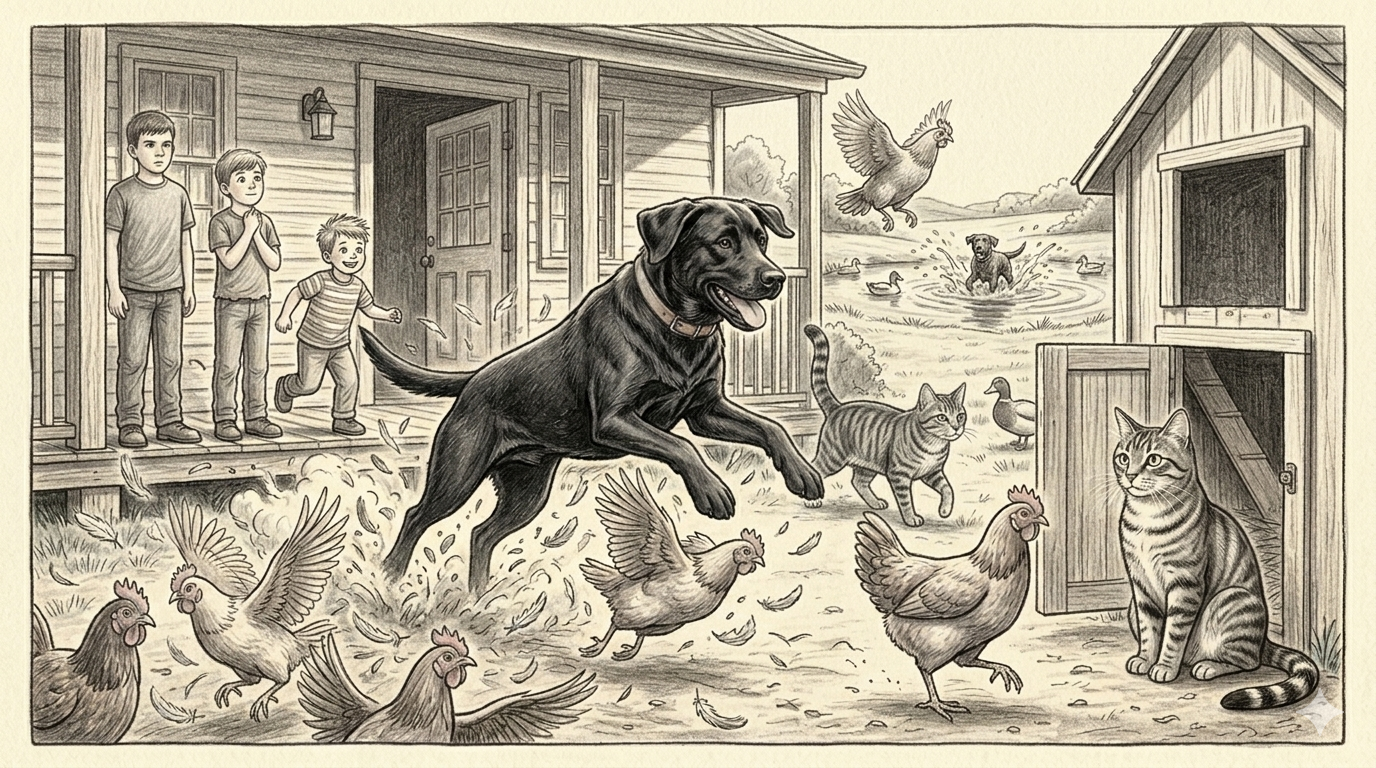
The scene in the yard was pure chaos. Eight chickens and three ducks had somehow escaped their coop and were scattered across the fifteen acres like feathered shrapnel. Dad was trying to corner a particularly defiant rooster near the fence line. Mom had appeared with a broom, attempting to sweep a duck toward the coop like the world’s most confused curling match.
Gunner assessed the situation with the tactical mind of a military general who had eaten too much breakfast and couldn’t think straight.
He charged.
The chickens exploded in every direction like feathered fireworks. The ducks quacked in terror and waddled frantically toward the pond. One chicken flew — actually flew — up onto the roof of the shed.
“GUNNER, YOU’RE MAKING IT WORSE!” the middle boy yelled.
But Gunner was committed now. He was helping. He was definitely helping. He bounded after a hen, barking encouragement, which only made her run directly away from the coop and straight into Mom’s vegetable garden. Mom said a word that the boys would later pretend they didn’t hear.
Tiger, meanwhile, had positioned himself strategically by the coop door. When one confused chicken wandered close, the cat simply sat there, unmoving, like a small striped sentinel — gray and brown tabby fur barely twitching, golden eyes locked on the bird with the patience of a creature who had never once in his life been in a hurry. The chicken, apparently hypnotized by the sheer force of Tiger’s indifference, walked right past him and into the coop.
“Did… did Tiger just herd a chicken?” Dad asked, stunned.
Tiger didn’t acknowledge the question. He didn’t need to.
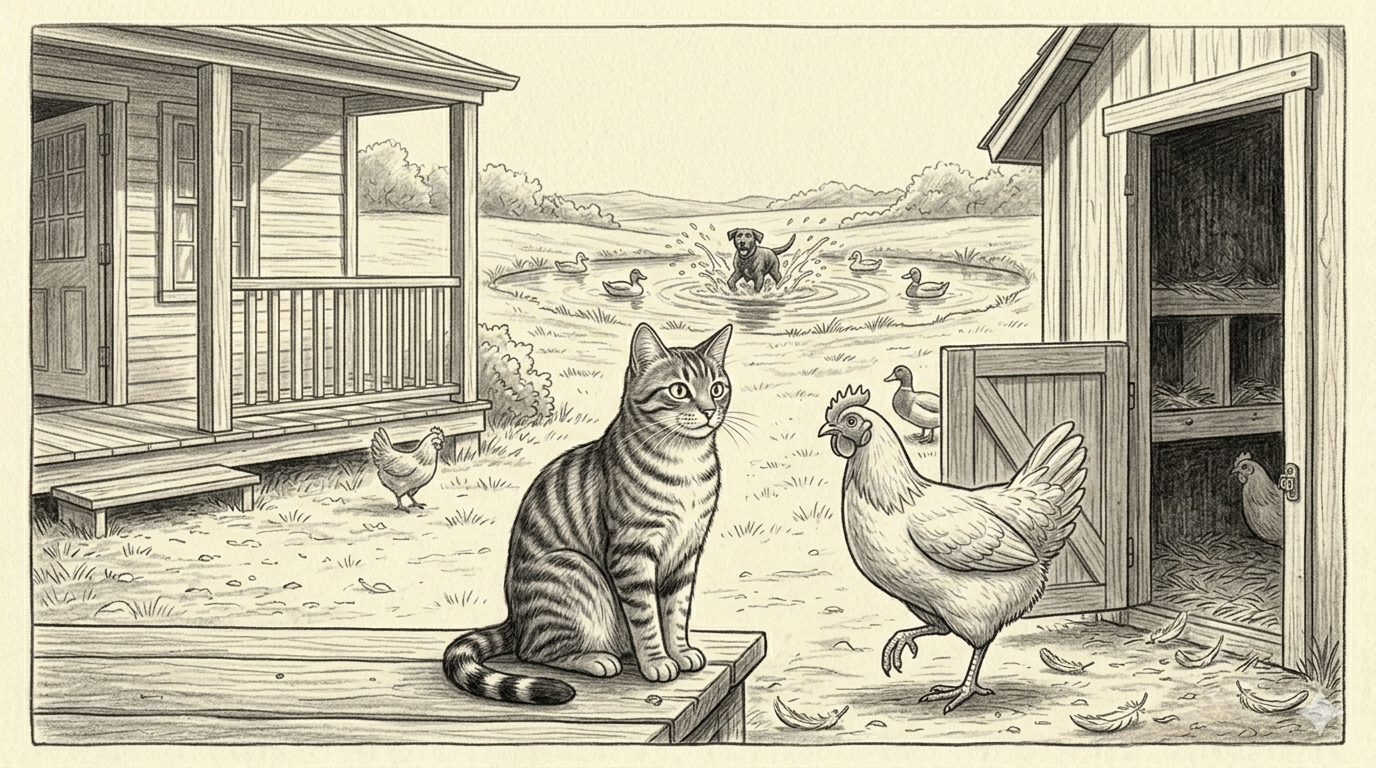
Gunner, oblivious to his friend’s success, was now in the pond. He wasn’t sure how he’d gotten there. One moment he was chasing ducks (helpfully), and the next moment he was swimming. The ducks, now in their element, bobbed nearby looking smug. One of them quacked directly at Gunner’s face. It felt personal.
The youngest boy giggled. Then the middle one started laughing. Soon all three boys were doubled over, and even Dad was shaking his head with a grin that said he should’ve known better.
It took another twenty minutes, but eventually, all the chickens and ducks were secured. Tiger had somehow herded three more chickens into the coop without moving more than five feet from his post. He’d simply sat there, radiating the quiet authority of a cat who understood that panic was beneath him. The chickens, one by one, wandered close, made eye contact with Tiger, and walked themselves right back inside like it was their idea.
Gunner had managed to herd exactly zero chickens but had successfully gotten completely soaked, covered in mud, trampled through the garden, spooked the ducks into the far end of the pond, and somehow had a stick stuck in his collar that nobody could explain.
As the family walked back toward the house, Gunner shook himself vigorously, spraying everyone within a six-foot radius. The boys shrieked and laughed, and Dad muttered something about “why do we even have a dog.”
But he was scratching Gunner behind the ears when he said it.
Then the youngest knelt down and wrapped his arms around Gunner’s wet, muddy neck. “Good boy, Gunner. You tried.”
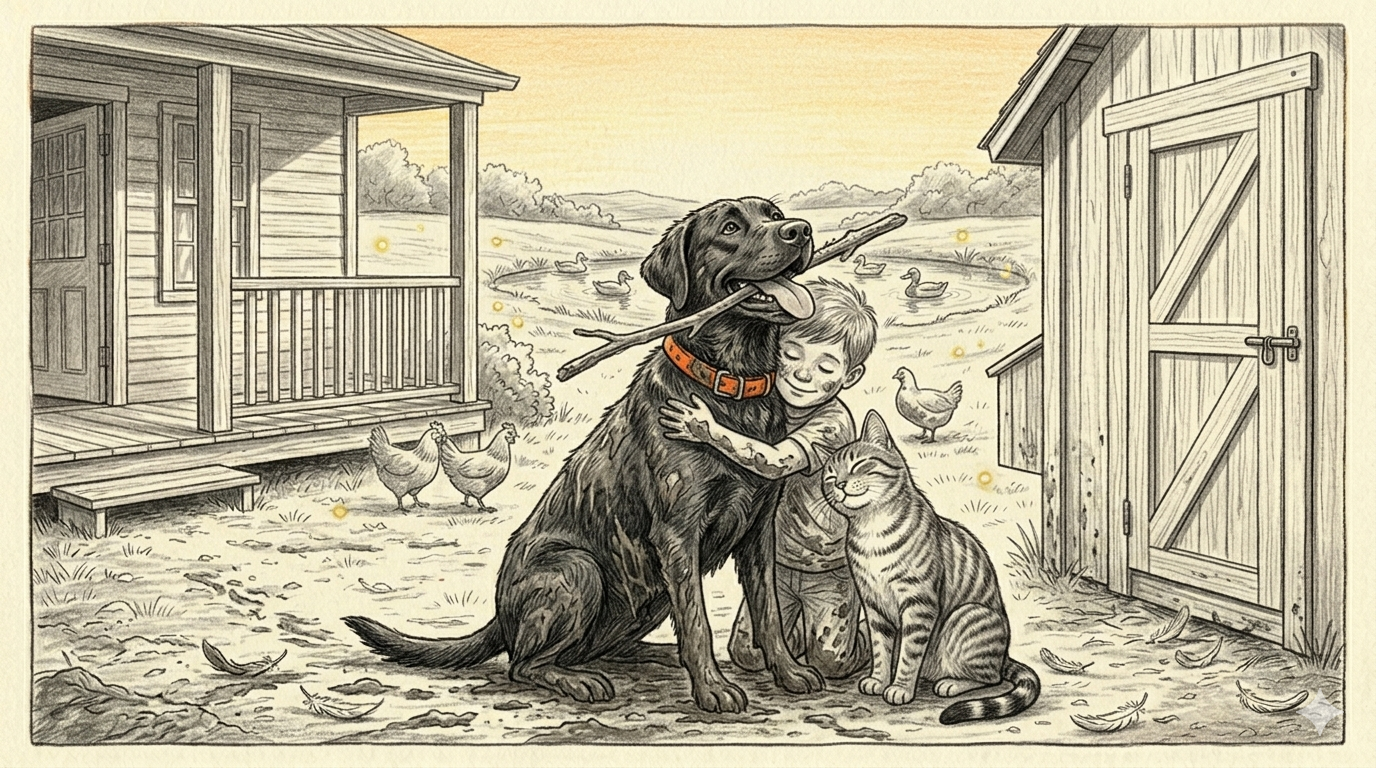
And there it was. Pets. Attention. Love.
Gunner’s tail wagged so hard his entire back half wiggled.
Tiger appeared beside him and rubbed against his leg, purring, which Gunner understood to mean: “You’re a disaster, but you’re my disaster.”
Inside, Mom was making breakfast. Gunner could smell bacon. He could always smell bacon. He could smell bacon from three counties over if the wind was right. And this bacon was close.
He looked at Tiger. Tiger looked at him. Without a word — without so much as a bark or a meow — they headed for the kitchen in perfect formation. Tiger low and silent. Gunner’s nails clicking on the floor like a ninety-pound announcement.
Because if there was one thing Gunner was truly great at, one skill that surpassed his chicken-herding abilities, one talent that was absolutely, positively, undeniable —
It was being in the exact right spot when food was about to accidentally fall on the floor.
And with three boys at the breakfast table, something always fell.
Tiger knew this too. He’d calculated the probability months ago.
But Gunner didn’t need math. He had instinct. He had hope. He had a nose that could detect a single dropped piece of bacon at forty paces.
And this morning, that was more than enough.