Donkeys, Ducks, and One More Thing
East Texas Homestead — Spring & Summer 2017
The first thing the family learned about their new homestead was that fifteen acres is a lot bigger when you actually own it.
In the photos online, fifteen acres had looked like a number. A line on a property listing. 15 acres, fenced, pond, barn, farmhouse. It had sounded manageable. It had sounded like a yard with some extra room.
It was not a yard with some extra room.
It was an entire small kingdom, and the family — fresh off the desert, wide-eyed and ambitious — had absolutely no idea what they had just bought.
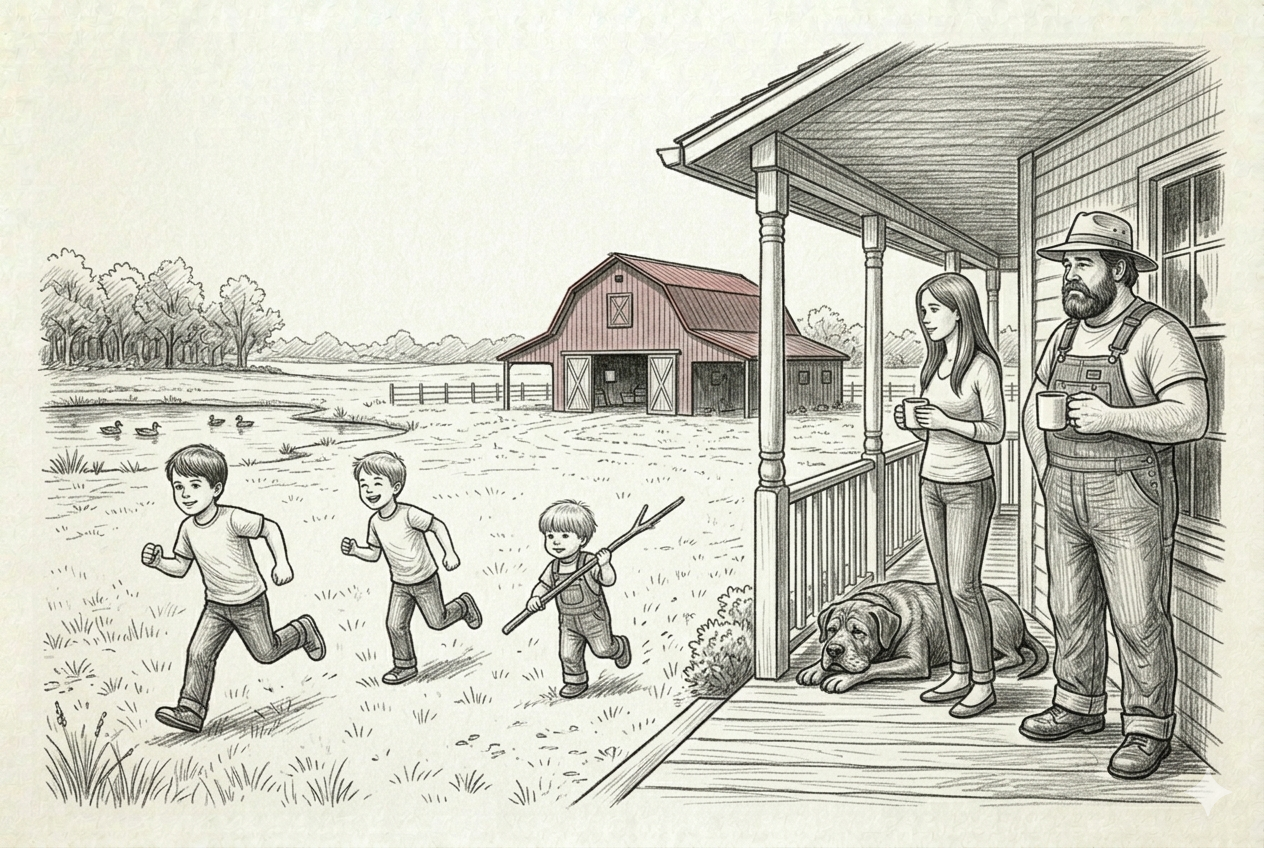
The boys figured it out first. The morning after they arrived, all three of them ran out the back door of the farmhouse and just kept running. They ran past the barn. They ran past the pond. They ran past the first fence line, and the second fence line, and a stand of trees Dad hadn’t even known was on the property until the youngest came back from it with a stick the size of his entire body.
“DAD!” the middle one yelled from somewhere in the distance. “THERE’S MORE!”
There was always more. That was the thing about fifteen acres. Every time you thought you’d seen all of it, there was another corner, another patch of woods, another little dip in the land where the pond drained into a creek you didn’t know about. The boys disappeared for hours that first week and came back covered in mud, scratched up, sunburned, and blissful.
Mom stood on the back porch with her coffee that first morning, watching them run, and said the thing she would say a lot over the next few years:
“This was a very good idea.”
Dad stood beside her with his own coffee. Bear lay between them on the porch, head on his paws, eyes half-closed, watching the boys run with the calm satisfaction of a dog whose new territory was so absurdly large that he had decided not to try to patrol all of it on day one.
“Yeah,” Dad said. “It was.”
The animals came in waves.
You don’t move onto a fifteen-acre homestead and not get animals. That’s not how it works. The land itself starts asking you for them. The empty barn looks at you. The empty pasture looks at you. The empty pond looks at you with the polite expectation of a place that has held animals before and would like to hold animals again.
The chickens came first. Eight of them, in a cardboard box from a feed store, peeping their tiny heads off all the way home. The boys named every single one of them within twelve minutes. There was Henrietta. There was Beans. There was a black-and-white speckled one the youngest named “Cow” because that was the most exciting word he knew. There was a hen the oldest insisted on calling “Number Four” because he was already, at six years old, an engineer at heart and felt names should be functional.
The chickens immediately took over the yard. Within a week, they were patrolling the porch like little feathered HOA inspectors, judging everyone’s footwear and pecking at anything that sparkled. Bear watched them with the confused expression of a city dog who had never, in five years of life, seen a bird walk before. The chickens, for their part, were entirely unimpressed by Bear. They walked right past him. One of them — Cow, of course — tried to peck his nose. Bear sneezed and got up and went inside. Bear had decided he did not, in fact, wish to have opinions about chickens.
The ducks came next. Four of them, white and waddling and convinced that the entire pond now belonged to them, which it did. They moved into the water on day one and never really came out again, except to argue with the chickens at the feeder and to chase the youngest boy across the yard when he got too close to their nest. The youngest learned a valuable life lesson that day: ducks are not friends. Ducks are neighbors, and they have boundaries.
Then came the donkeys.
This was Mom’s idea. Mom had read somewhere that donkeys made excellent guardians for small homesteads — that they would protect chickens from coyotes and ducks from foxes and would generally patrol the property like grumpy little four-legged sheriffs. Dad was skeptical. Dad had grown up in the country and had never personally known a donkey to do anything other than stand there and look offended.
But the donkeys came anyway. Two of them. A big gray one and a smaller brown one. The boys named them, of course — within minutes, the gray one was Mr. Snickers and the brown one was Beep, for reasons the middle boy could not adequately explain even when pressed.
Mr. Snickers and Beep walked off the trailer, surveyed their new pasture, looked at the chickens, looked at the ducks, looked at the boys, looked at Bear, looked at Dad, looked at each other —
And then Mr. Snickers brayed.
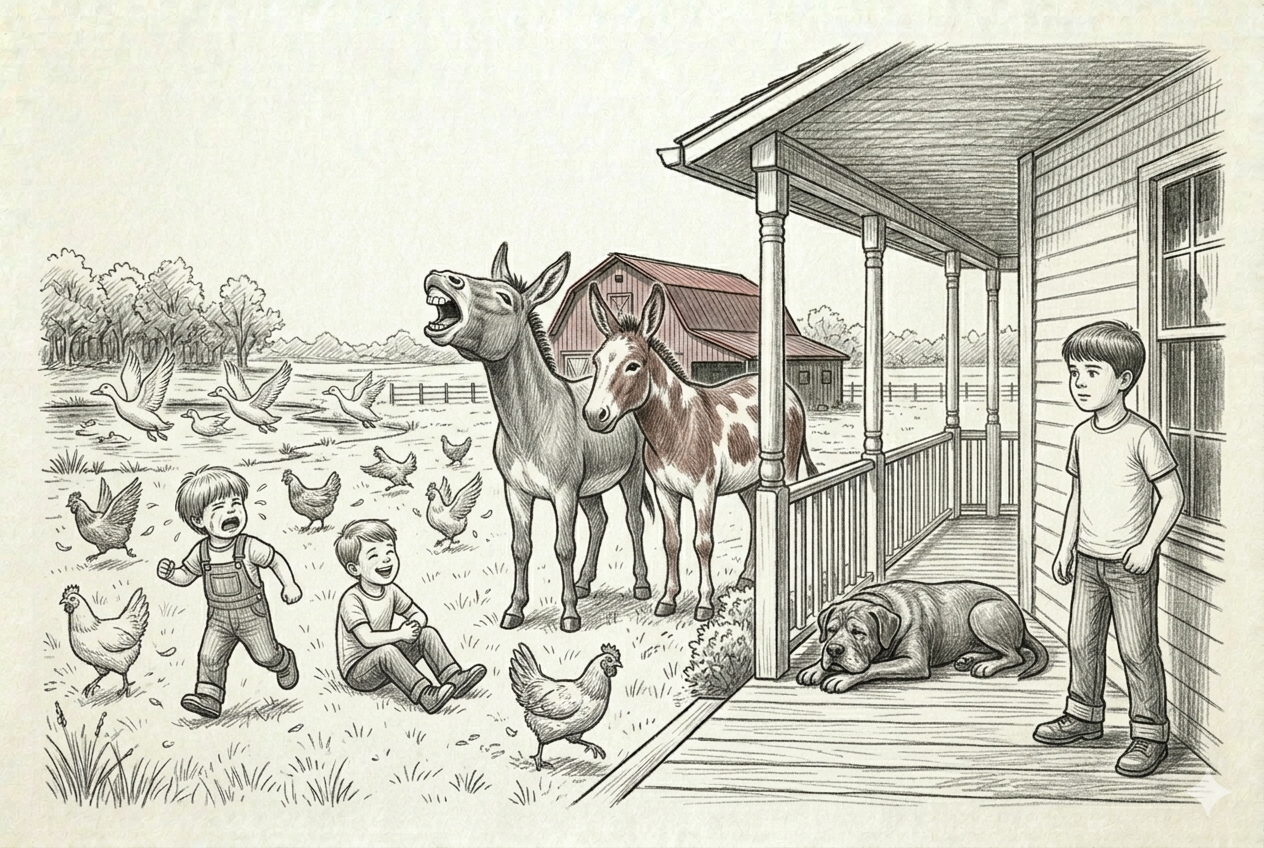
If you have never heard a donkey bray up close, the closest comparison is a foghorn being strangled by a chainsaw. It’s a sound that comes from somewhere ancient and angry and very, very loud. The chickens scattered. The ducks took flight in formation, which was the first time anyone in the family had ever seen ducks fly anywhere. The youngest burst into tears. The middle boy started laughing so hard he sat down in the grass. The oldest just stared with the slow-blinking expression of a kid recalculating his understanding of the universe.
Bear, on the porch, lifted his head exactly one inch off his paws, considered the situation, and put his head back down.
Bear had decided, in that moment, that donkeys were Mom’s problem.
By summer, the homestead had a rhythm.
The chickens had a coop. The ducks had a pond. The donkeys had a pasture and a job that mostly consisted of standing in the middle of it looking suspicious. Mom had a garden going. Dad had built three things and broken two of them, which he counted as a win. The boys had developed actual farm-kid calluses on their hands from carrying water buckets, throwing scratch grain, and pulling each other in the wagon.
Bear had become the unofficial supervisor of all of it.
Not because he wanted to be. Bear had not asked for this job. Bear had spent five years in Phoenix being a perfectly reasonable suburban dog, and now suddenly he was responsible for the moral oversight of a pond, a pasture, eight chickens, four ducks, two donkeys, and three small humans who could not be trusted alone with any of the above. He took the job seriously despite himself. He would walk the perimeter of the yard every morning like a small graying foreman doing inspections. He would lie in the shade of the oak tree by the pond and keep one eye open whenever the boys waded in. He would, on occasion, give the chickens a meaningful look that said don’t even.
The chickens did not care about Bear’s meaningful looks. But that was okay. Bear had stopped expecting anything from chickens.
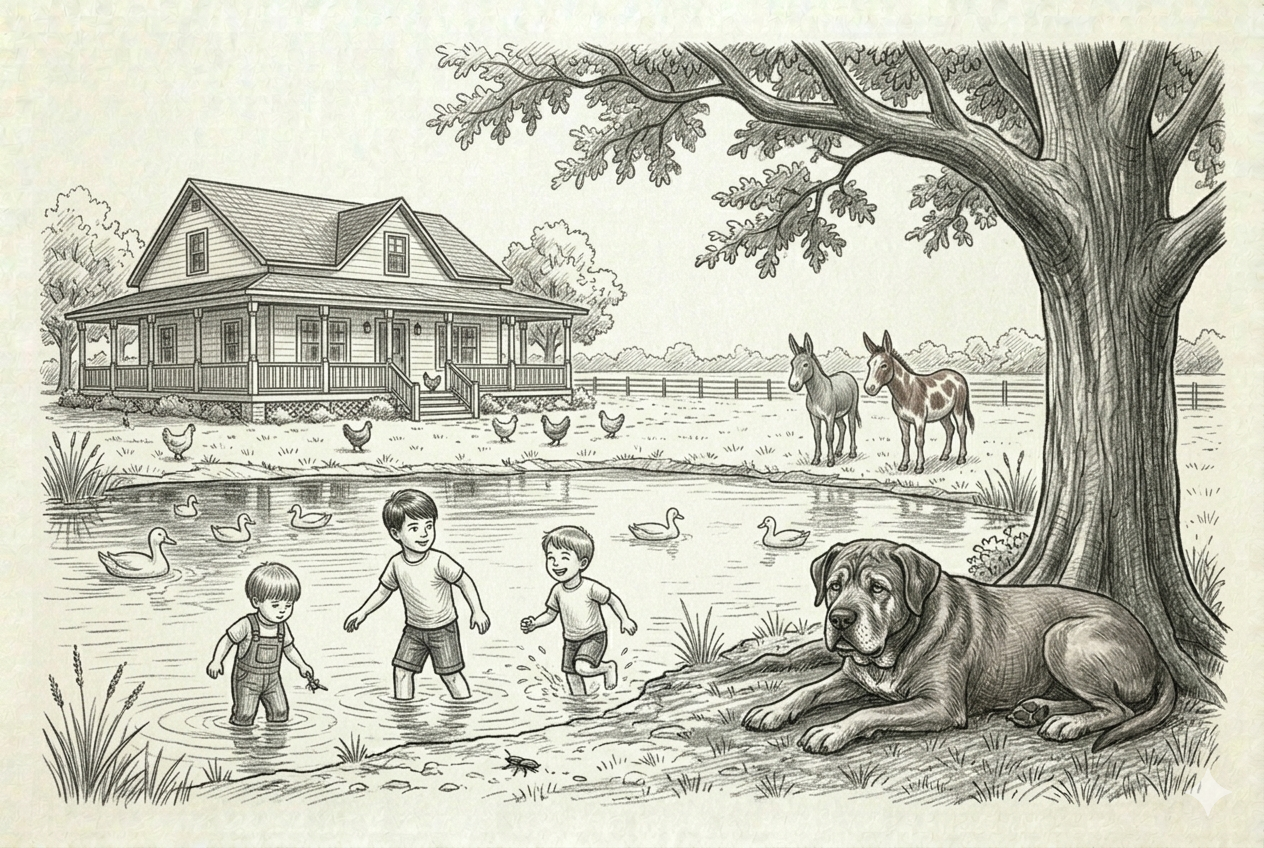
This was the homestead in early summer 2017. Full. Loud. Smelly. Alive. The kind of place where you woke up to a rooster instead of an alarm clock, where the boys came in for lunch with mud up to their knees, where you could stand on the back porch at night and hear nothing for miles except cicadas and frogs and the occasional bray of Mr. Snickers reminding the world that he existed.
It was good.
But Dad — and only Dad knew this, because Dad was keeping a small secret — Dad thought it could be just a little better.
Dad had been thinking about a dog.
A second dog. Not to replace Bear. Nobody could replace Bear, and Bear would have personally murdered anyone who tried. But a second dog. A dog for the boys to grow up with. A dog who would be a puppy when the youngest was still small, so they could grow up at the same time and be best friends from the beginning. A dog with energy. A dog with patience. A dog who would love being out on fifteen acres and would want to be in the pond and the woods and the pasture every single day of his life.
A Lab. It had to be a Lab. Dad had grown up around Labs. He knew them the way you know an old hymn — by heart, every verse, every note. The sweetness. The goofiness. The bottomless appetite. The way a good Lab would lay his head on your knee at the end of a hard day and just be there, the warm steady weight of him doing more for your tired soul than any human conversation ever could.
A black Lab. That was the picture in his head. A black Lab puppy growing up alongside three small boys on fifteen acres of East Texas.
Dad had been quietly looking for weeks. He had not told Mom, because Mom had her hands very full with the homestead and the boys and the garden and the chickens and the donkeys and a husband who kept “building things.” He had not told the boys, because the boys could not keep a secret to save their lives. He had only told Bear.
Bear had received the news with the long, considered silence of an elder dog being informed that he would soon be sharing his porch. Bear had not said yes. Bear had not said no. Bear had simply looked at Dad with one eyebrow slightly raised, the way Bear looked at most things, and gone back to sleep.
Dad had taken this as a tentative approval.
The day Dad found him, it was hot.
A breeder a couple of hours away had a litter. Eight black Lab puppies, all healthy, all wiggling, all about seven weeks old. Dad drove out alone on a Saturday morning while Mom and the boys were doing something with the donkeys. He told Mom he was running errands. Technically, this was true. He was running the most important errand of his life.
The puppies were in a whelping box in a barn. Eight of them, climbing over each other, falling on each other, biting each other’s ears, falling asleep in piles, waking up confused, falling asleep again. It was the kind of scene that liquefies the brain of any adult human who walks into it. Dad knelt down beside the box and just looked for a minute, because looking was the only thing he was capable of doing.
Then one of them came over.
A solid black male, slightly bigger than his siblings, with paws too large for his body and the kind of warm amber eyes that looked at you like he had been waiting his whole short life for you specifically to show up. He toddled over to the edge of the box, sat down with great effort, and looked up at Dad. His tail thumped against the wood once. Thump. Then twice. Thump thump.
Dad picked him up.
The puppy was warm and heavy and smelled like puppy — that specific milky, earthy, indescribable smell that nature invented to ensure the survival of the species. He fit in the curve of Dad’s arm like he had been measured for it. He yawned once, his tiny pink tongue curling, and then he laid his enormous oversized head against Dad’s chest and closed his eyes.
That was it. That was the whole search. That was the whole decision.
Dad walked out of that barn forty-five minutes later with a black Lab puppy zipped into the front of his denim jacket, with only the puppy’s nose and one floppy ear sticking out, and a receipt in his back pocket that he was not entirely sure how he was going to explain to Mom.
He drove home one-handed.
The puppy slept the whole way.
Mom was on the porch when Dad pulled up the long dirt driveway.
She had her hands on her hips. The boys were in the yard playing some game that involved sticks and rules nobody else could follow. Bear was in his spot in the shade of the oak tree, watching everything with one eye open. The chickens were doing chicken things. The donkeys were doing donkey things, which was mostly standing.
Dad got out of the truck.
Mom’s eyes went immediately to the front of his jacket. Mom was a mom. Mom did not miss things. Mom had spotted the very small, very moving lump in the front of Dad’s jacket from approximately fifty yards away and was already doing the math.
“What is in your jacket.”
Dad held up both hands in the universal gesture of please don’t be mad.
“What. Is. In. Your. Jacket.”
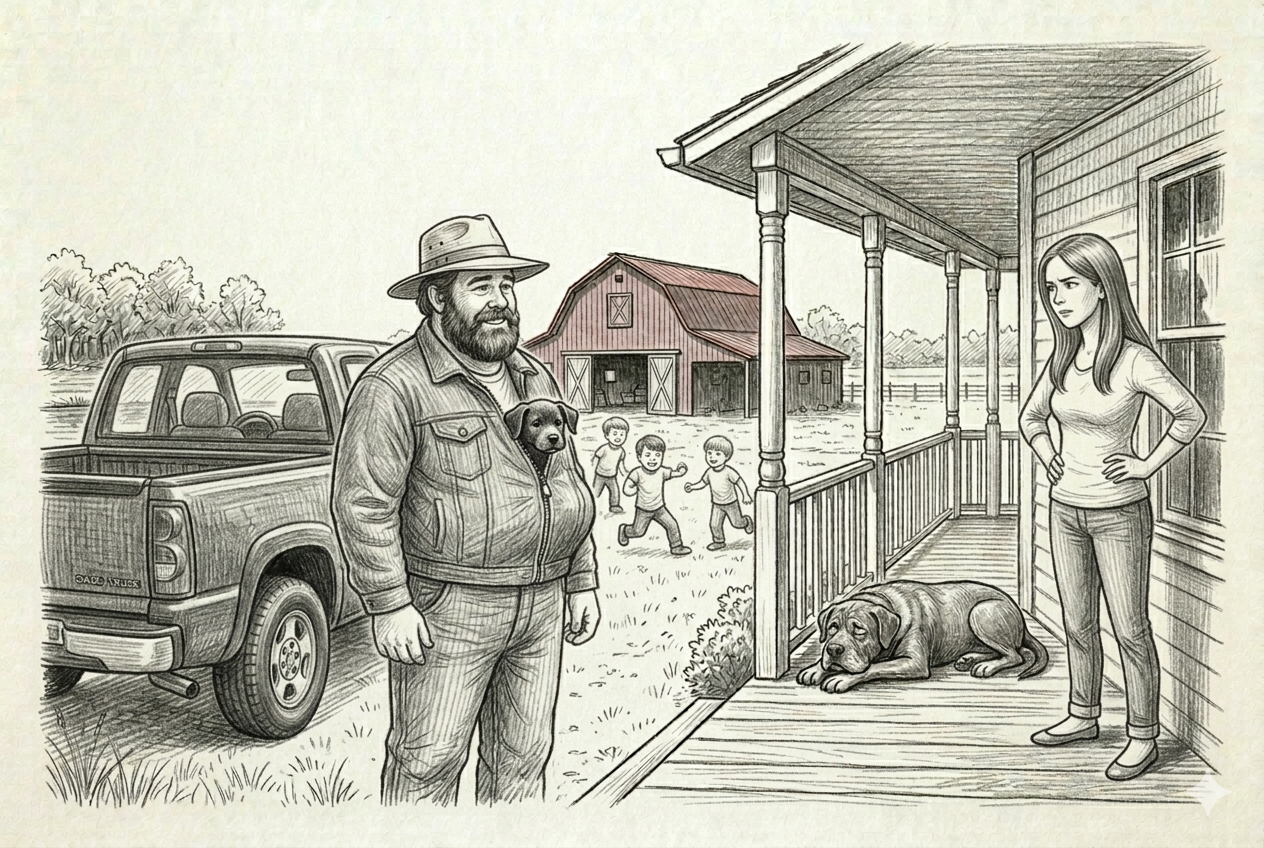
The boys had heard her tone. The boys had stopped playing. Three small heads turned toward Dad in perfect unison. Three sets of eyes locked onto the lump.
Dad slowly, slowly, unzipped the front of his jacket.
A small black head poked out. Big floppy ears. Warm amber eyes. A tiny pink tongue. The puppy looked around at the porch, at Mom, at the three boys frozen in the yard, at the chickens, at the donkeys in the distance, at Bear under the oak tree — and his tail, his impossibly small puppy tail, started wagging so hard his whole back end wiggled inside the jacket.
The yard exploded.
The youngest screamed. Just a pure unfiltered scream of joy, the kind only a two-year-old can produce, the kind that comes from somewhere deeper than language. He started running toward Dad. The middle boy was right behind him, both hands already out, eyes huge. The oldest — the workhorse, the serious one — actually broke into a sprint, which was something the oldest almost never did.
“PUPPY.”
“PUPPY.”
“DAD HE’S A PUPPY.”
Mom put both hands over her face.
“Are you serious right now.”
But Dad could see her. He could see her hands, and he could see the shape of the smile she was hiding behind them, and he knew that he had won. He had not been sure he was going to win — bringing a puppy home unannounced was, by any reasonable measure, a divorce-level surprise — but he had been hoping, and the puppy had clearly hoped along with him, and now it was happening.
The boys descended.
Six small hands, all reaching at once. Dad knelt down in the dirt of the driveway and let them. The puppy was passed from arm to arm with the careful, breathless ceremony of three boys who had never held something so small and so important. He licked the youngest’s face. He licked the middle boy’s nose. He licked the oldest right in the eye, because the oldest had gotten too close. The oldest didn’t even flinch. The oldest just sat there in the dirt, a dignified six-year-old being licked in the eye by a puppy, and he was grinning so hard his face hurt.
“What’s his name?” the middle boy whispered.
Dad opened his mouth to say I haven’t picked one yet.
But Mom — who had walked down off the porch by now, who had given up on being mad, who was kneeling in the dirt with the boys — Mom was looking at the puppy. She had reached out one finger to scratch under his chin. The puppy was leaning into her hand with his eyes closed.
“Gunner,” Mom said quietly.
Dad looked at her.
“Gunner,” she said again, like she was trying it on. “Look at him. He looks like a Gunner.”
The puppy opened his eyes and looked right at her when she said it the second time. His tail thumped once against the youngest boy’s knee. Thump.
Like he had heard his name. Like he had been waiting to hear it.
“Gunner,” the youngest whispered, the way you whisper a magic word.
“Gunner,” the middle one repeated.
“Gunner,” the oldest said, in his serious oldest-boy voice, like he was making it official.
And just like that — in the dirt of a long East Texas driveway, in the late spring of 2017, with eight chickens watching from the porch and two donkeys watching from the pasture and four ducks watching from the pond and Bear watching from under the oak tree — the puppy became Gunner.
He was Gunner from that moment on. He had probably been Gunner from the moment he was born, and he had just been waiting for the right people to find him and figure it out.
Bear, under the oak tree, had been watching the entire scene with the slow, considered patience of an elder dog.
He had watched Dad pull up the driveway. He had watched the unzipping of the jacket. He had watched the small black head appear. He had watched Mom give in. He had watched the boys descend like a small loving avalanche. He had watched the puppy get passed from hand to hand like a sacred object.
And he had watched, with the very specific resignation of a dog who had spent five years as the only dog in this family, the moment the puppy was officially named.
Bear got up.
Slowly. With dignity. The way old patriarchs get up when they have decided to make their position known. He walked across the yard at his unhurried Bear pace. The boys, who knew Bear’s pace, parted slightly to make room for him. Mom watched. Dad watched.
Bear walked up to the puppy — Gunner — who was wiggling in the youngest boy’s arms.
The puppy saw him.
The puppy froze.
This was the biggest creature the puppy had ever seen in his short life. Bigger than his mom. Bigger than his siblings combined. Brown and graying and serious-eyed and very up close. The puppy went absolutely still in the youngest’s arms. His tail stopped wagging. His tiny puppy heart, you could practically see it through his chest.
Bear leaned in.
He sniffed the puppy from nose to tail with the slow professional thoroughness of a dog who had been doing this kind of inspection for years. The puppy did not move. The puppy did not breathe. The youngest boy did not move. The youngest boy did not breathe.
Bear finished his inspection.
He looked at the puppy. The puppy looked at Bear.
Bear let out a long, slow sigh — the Bear sigh, the one that had been honed over five years in Phoenix and refined in two months on the East Texas homestead, the sigh that contained entire novels of opinion compressed into a single exhalation.
And then Bear — slowly, deliberately, with the air of a king deciding the fate of a small ridiculous prince — leaned forward and gave Gunner one single, dignified lick on the top of the head.
One lick.
That was all he was offering.
Then Bear turned around, walked back to his spot under the oak tree, and lay down again.
The boys exploded in cheers.
“BEAR LIKES HIM!”
“BEAR LIKED HIM!”
“BEAR GAVE HIM A KISS!”
Bear, under the oak tree, did not look up. Bear did not need to look up. Bear had said his piece. The new dog was acceptable. The new dog was family, now, by the official authority of the oldest dog in residence. Whatever happened from here on out — and Bear could already tell, from one sniff, that a lot was going to happen from here on out — was going to happen with Bear’s grudging blessing.
Gunner, in the youngest boy’s arms, slowly started to wag his tail again.
And then he wagged it harder.
And then his entire back half started to wiggle.
Because somewhere in that tiny puppy brain, he had just understood something that would shape every single day of the rest of his life:
These are my people now.
That is my big brother.
This is my home.
The boys carried Gunner everywhere for the rest of that afternoon. They showed him the chickens, who were unimpressed. They showed him the ducks, who quacked aggressively from a safe distance. They showed him the donkeys, who looked down at him with mild curiosity and then went back to standing. They showed him the pond, which Gunner stared at with the deep philosophical interest of a Lab who did not yet know what water was but suspected, on some genetic level, that he was going to love it very much.
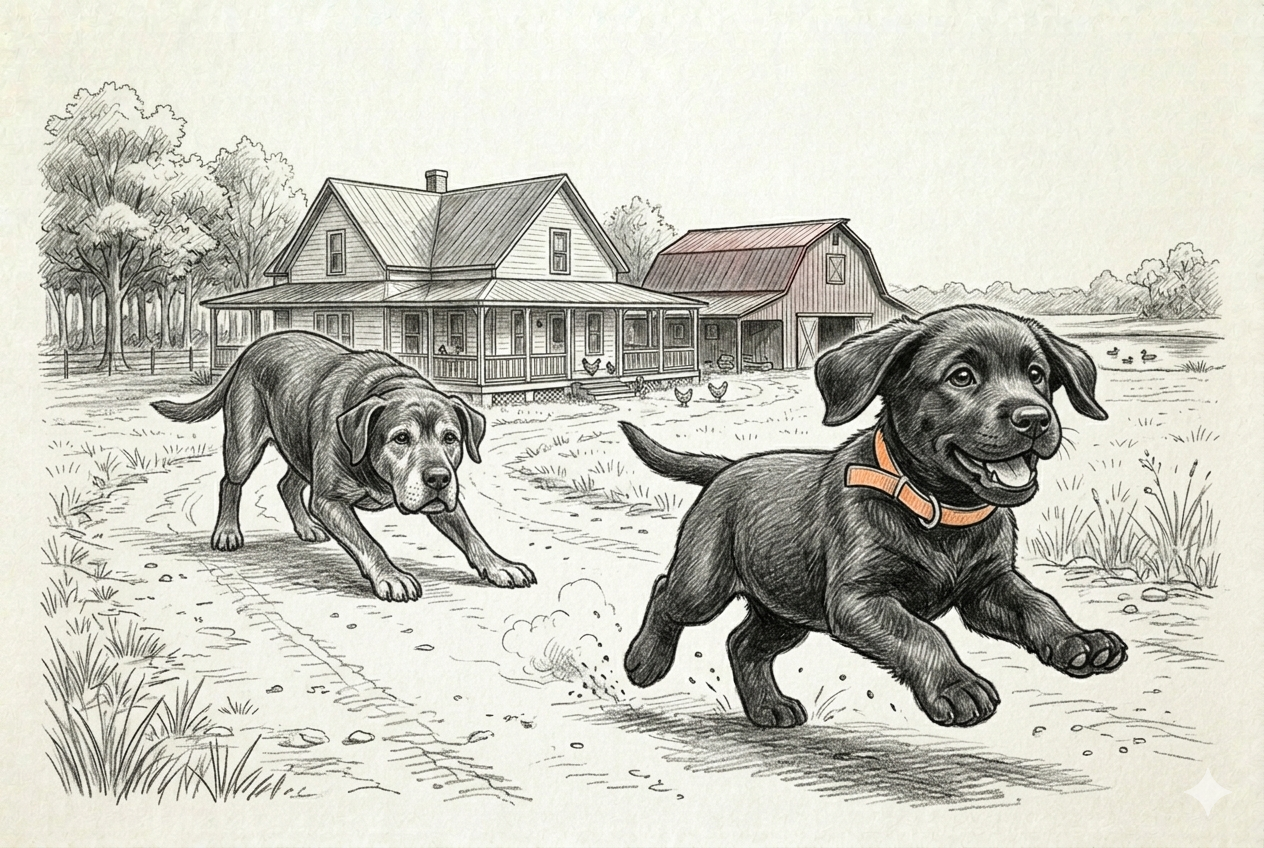
Mom made up a small bed for him in the kitchen, near where Bear slept. That first night, the puppy whimpered for about ten minutes and then stopped. The family later figured out that he had stopped because he had quietly waddled across the kitchen floor and curled up against Bear’s back — without permission, without invitation, without even checking to see if it was okay.
Bear had not moved.
Bear had not growled.
Bear had let it happen.
In the morning, when Mom came down to start coffee, that was how she found them: an old brown patriarch and a tiny black puppy, asleep together on Bear’s bed by the kitchen door. Bear had one paw resting protectively over the puppy’s back. The puppy was snoring.
Mom stood there in her pajamas with her hand over her mouth and didn’t make coffee for almost ten minutes, because she didn’t want to wake them up.
That was the first morning of the rest of the series.
That was the morning everything began.
Next time: Tiger arrives. He is very small, very loud, and very sure that the giant black dog who keeps trying to play with him is going to be the warmest pillow in the entire state of Texas.